Sequential SG experiments
Task number: 4408
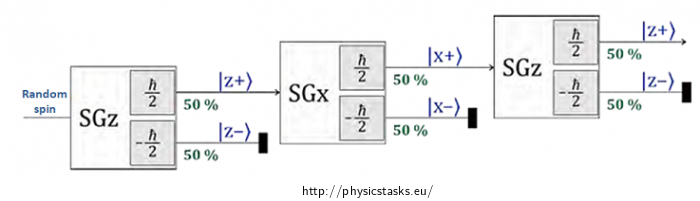
Using a Stern–Gerlach apparatus oriented along the \(z\)‑axis, we select from the initially unpolarised beam only those electrons whose spin has a positive projection onto the \(z\)‑axis. This beam is then passed through a second Stern–Gerlach apparatus oriented along the \(x\)‑axis. If the beam splits, we again select the component with a positive spin projection. This selected beam is then passed through a Stern–Gerlach apparatus oriented once more along the \(z\)‑axis. Determine the ratios in which the beams split in each apparatus, and explain the difference from classical behaviour.
Hint 1
Recall or look up the matrix forms of the spin‑\(\frac{1}{2}\) projection operators along the \(x\)‑ and \(z\)‑axes, and derive or look up their eigenvalues and the corresponding eigenvectors.
Hint 2
Recall or look up how to decompose the state entering the measurement, and how the probabilities of obtaining the individual measurement outcomes can be determined from this decomposition.
Solution
Since the electrons entering the first Stern–Gerlach apparatus have a random spin orientation, the two possible values of the spin projection onto the \(z\)‑axis are obtained with equal probability, namely \(P_+ = P_- = \frac{1}{2}\). Owing to this, we also know the state vectors describing the electrons in both cases. We select only those electrons whose spin projection onto the \(z\)‑axis is \(+ \frac{\hbar}{2}\). The eigenvector corresponding to this eigenvalue is \(\left |z+ \right \rangle = \begin{pmatrix} 1\\ 0 \end{pmatrix}\).
The electron beam in this state then passes through a Stern–Gerlach apparatus oriented along the \(x\)‑axis. According to the measurement axiom, to determine the probabilities of the two possible outcomes, we must decompose the state entering the measurement into a linear combination of the eigenstates of the observable being measured. We therefore seek the decomposition
\[ |z+\rangle = c_1 |x+\rangle + c_2 |x-\rangle \, , \]where \(c_1\) and \(c_2\) are, for the moment, unknown complex constants.
We now substitute the corresponding eigenvectors
\[ \begin{pmatrix} 1\\ 0 \end{pmatrix} = c_1 \frac{1}{\sqrt{2}} \begin{pmatrix} 1\\ 1 \end{pmatrix} + c_2 \frac{1}{\sqrt{2}} \begin{pmatrix} -1\\ 1 \end{pmatrix} \, . \]We then write this equation out component by component, thereby obtaining a system of two linear equations for the two unknowns
\[ 1 = \frac{c_1}{\sqrt{2}} - \frac{c_2}{\sqrt{2}} \, , \] \[ 0 = \frac{c_1}{\sqrt{2}} + \frac{c_2}{\sqrt{2}} \, . \]Adding these equations and solving for the coefficient \(c_1\) yields
\[ 1 = \frac{2c_1}{\sqrt{2}} \,\, \rightarrow \, \, c_1 = \frac{1}{\sqrt{2}} \, . \]Moreover, the second equation immediately shows that \(c_1 = - c_2\), and therefore
\[ c_2 = - \frac{1}{\sqrt{2}} \, . \]The required decomposition thus takes the form
\[ |z+\rangle = \frac{1}{\sqrt{2}} |x+\rangle - \frac{1}{\sqrt{2}} |x-\rangle \, . \]The probabilities of measuring the individual values are equal to the squared magnitudes of the corresponding coefficients, i.e.,
\[ P_+ = \left |c_1 \right |^2 = \frac{1}{2} \, , \] \[ P_- = \left |c_2 \right |^2 = \frac{1}{2} \, . \]We see that both outcomes have the same probability of being measured, so the beam splits into two beams of equal intensity. We select the beam with a positive spin projection along the \(x\)‑axis and let it pass through a Stern–Gerlach apparatus oriented again along the \(z\)‑axis. In analogy with the previous step, we decompose the state \(|x+\rangle\) entering the Stern–Gerlach apparatus as
\[ |x+\rangle = d_1 |z+\rangle + d_2 |z-\rangle \, , \]where \(d_1\) and \(d_2\) are the complex coefficients to be determined.
By substituting the eigenvectors and expanding into individual components, we immediately obtain
\[ \frac{1}{\sqrt{2}} = d_1 \, , \] \[ \frac{1}{\sqrt{2}} = d_2 \, . \]The resulting decomposition is
\[ |x+\rangle = \frac{1}{\sqrt{2}} |z+\rangle + \frac{1}{\sqrt{2}} |z-\rangle \, . \]The probabilities of measuring each value are, as always, equal to the squared magnitudes of the corresponding coefficients, i.e.,
\[ P_+ = \left |d_1 \right |^2 = \frac{1}{2} \, , \] \[ P_- = \left |d_2 \right |^2 = \frac{1}{2} \, . \]The measurement of both possible spin projection values is therefore again equally probable. This clearly illustrates how measuring the spin projection along the \(x\)‑axis with a second Stern–Gerlach apparatus “erased” the information about the spin projection along the \(z\)‑axis. This contrasts with classical behaviour, where one might expect that once electrons with a negative spin projection along the \(z\)‑axis have been filtered out, they should not reappear, because in classical measurements the spin projection would not be affected—which is not the case in quantum mechanics.
The calculations presented above are also summarised schematically in the figure, adapted from Chapter 6 of the lecture notes Quantum Physics (Not Only) for Future Teachers for the course Introduction to Quantum Mechanics and Quantum Theory.
Answer
In all the apparatuses, the beams split in half, with one half having a positive spin projection and the other half a negative spin projection.
Unlike in classical behaviour, where we would not expect the negative spin projection along the \(z\)‑axis to reappear, here, because the measurement affects the electron’s state, this projection is indeed observed.
Comment – calculation of the decomposition coefficients using the scalar product
The sought coefficients \(c_1, \, c_2\) of the decomposition
\[ |z+\rangle = c_1 |x+\rangle + c_2 |x-\rangle \]can be determined using the scalar product
\[ c_1 = \langle x+ | z+ \rangle = \frac{1}{\sqrt{2}} \begin{pmatrix} 1 & 1 \end{pmatrix} \begin{pmatrix} 1 \\ 0 \end{pmatrix} = \frac{1}{\sqrt{2}} \, , \] \[ c_2 = \langle x- | z+ \rangle = \frac{1}{\sqrt{2}} \begin{pmatrix} -1 & 1 \end{pmatrix} \begin{pmatrix} 1 \\ 0 \end{pmatrix} = - \frac{1}{\sqrt{2}} \, . \]Analogously, we proceed to find the coefficients \(d_1, \, d_2\) of the decomposition
\[ |x+\rangle = d_1 |z+\rangle + d_2 |z-\rangle \, . \]Using the scalar product, the coefficients are determined as
\[ d_1 = \langle z+ | x+ \rangle = \frac{1}{\sqrt{2}} \begin{pmatrix} 1 & 0 \end{pmatrix} \begin{pmatrix} 1 \\ 1 \end{pmatrix} = \frac{1}{\sqrt{2}} \, , \] \[ d_2 = \langle z- | x+ \rangle = \frac{1}{\sqrt{2}} \begin{pmatrix} 0 & 1 \end{pmatrix} \begin{pmatrix} 1 \\ 1 \end{pmatrix} = \frac{1}{\sqrt{2}} \, . \]Both methods—solving a system of two linear equations for two unknowns or using the scalar product—are correct and yield the same results.