SG experiment – superposition state vs. mixed state
Task number: 4410
Consider two beams of particles with spin \(\frac{1}{2}\). The particles in the first beam are in the superposition state
\[ |\psi\rangle = \frac{\sqrt3}{2}|z+\rangle + \frac{1}{2}|z-\rangle \, , \]where \(|z+\rangle, \, |z-\rangle\) are the eigenstates of the spin‑\(\frac{1}{2}\) projection along the \(z\)‑axis.
The particles in the second beam are in a mixed state
\[ \frac{\sqrt3}{2}|z+\rangle, \, \frac{1}{2}|z-\rangle \, . \]Using the applet, determine how the probabilities of measuring the two possible spin‑\(\frac{1}{2}\) projections along the \(z\)‑ and \(x\)‑axes differ for these states. Subsequently, verify your conclusions by explicit calculation.
Hint 1
Recall or look up the difference between a superposition state and a mixed state.
Hint 2
Recall or look up how to decompose the state entering the measurement, and how the probabilities of obtaining the individual measurement outcomes can be determined from this decomposition.
Hint 3
Calculate or look up the form of the eigenvectors of \(\hat S_z\) and \(\hat S_x\).
Applet – description and settings
At the link provided in the assignment, you can find an applet focusing on the difference between superposition states and mixed states. In this applet, the Step‑by‑step Explanation tab contains further hints that may help you to understand this topic.
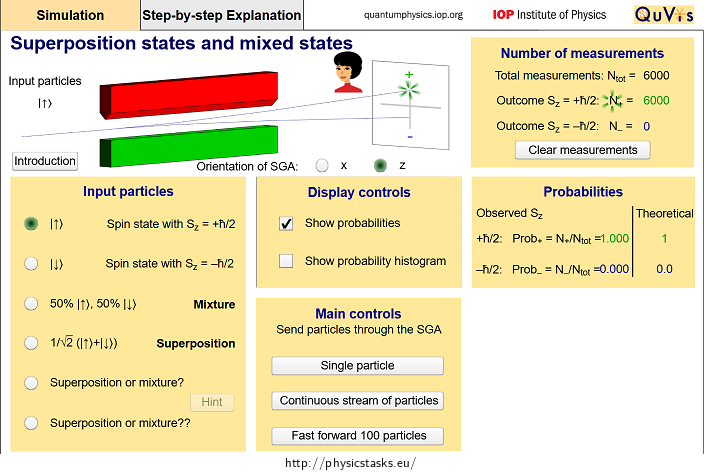
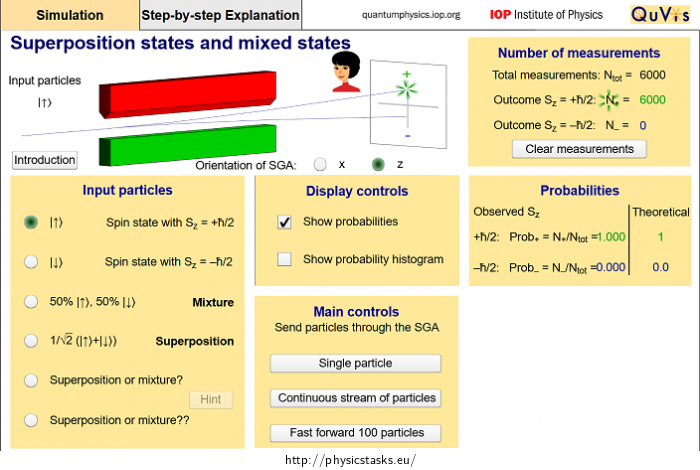
After opening the applet, click on the Simulation tab in the top‑left corner. At the bottom of the left‑hand panel, you can select, by clicking, which state the particles will be sent in through the Stern–Gerlach apparatus. Directly beneath the schematic representation of the apparatus at the top, you can choose the orientation of the Stern–Gerlach apparatus. Below this, you have the option to display the probabilities and the probability histogram. When using the applet, we strongly recommend keeping at least the Show probabilities box checked. In the centre of the lower panel, you will find the Main controls, where you can choose how to send particles into the apparatus. We recommend performing measurements by repeatedly sending 100 particles at a time, as other settings would make the measurement take considerably longer. Measurement results are displayed in the right‑hand panel. For guidance, we provide a record from the applet for particles in the state \(|z+\rangle\) entering the Stern–Gerlach apparatus oriented along the \(z\)‑axis, with only Show probabilities checked. We further recommend conducting all measurements with a sufficiently large number of incoming particles (values around 5000 give results that closely match theoretical predictions).
You can also try the reverse task here. By checking Superposition or mixture? and Superposition or mixture??, you can perform a measurement to determine whether the state is a superposition state or a mixed state. From the measured probabilities, you can then deduce the description of these states.
Solution – using the applet
If we send a beam of particles in a superposition state into a Stern–Gerlach apparatus oriented along the \(z\)‑axis, we find that the probabilities of measuring the two spin‑\(\frac{1}{2}\) projections coincide with the probabilities we would obtain by sending a beam of particles in a mixed state. In this measurement, therefore, the superposition state is indistinguishable from the mixed state.
Now, if we orient the Stern–Gerlach apparatus along the \(x\)‑axis and send a beam of particles in a mixed state, both spin projections are measured with equal probability \(\frac{1}{2}\). In contrast, if we send in a beam of particles in a superposition state, each spin projection is measured with a different probability.
Solution – measurement of the spin‑1/2 projection along the z‑axis
Consider the Stern–Gerlach apparatus oriented along the \(z\)‑axis. According to the measurement axiom, the superposition state \(|\psi\rangle\) must be expressed as a linear combination of the eigenstates of the spin‑\(\frac{1}{2}\) projection along the \(z\)‑axis, with the probabilities of measuring each projection given by the squared magnitudes of the coefficients of the corresponding eigenstates
\[ |\psi\rangle = c_1|z+\rangle + c_2|z-\rangle \, , \]where \(c_1, \, c_2\) are the complex coefficients to be determined. Since the superposition state is already given as \(|\psi\rangle = \frac{\sqrt3}{2}|z+\rangle + \frac{1}{2}|z-\rangle\), we can immediately identify
\[ c_1 = \frac{\sqrt3}{2}, \, c_2 = \frac{1}{2}, \]and therefore
\[ P_+ = |c_1|^2 = \left( \frac{\sqrt3}{2} \right)^2 = \frac{3}{4} = 75 \, \% \, , \] \[\] \[ P_- = |c_2|^2 = \left( \frac{1}{2} \right)^2 = \frac{1}{4} = 25 \, \% \, . \]In the case of a mixed state, we can immediately state that the probabilities of measuring the spin‑\(\frac{1}{2}\) projection to be positive, \(P_+\), or negative, \(P_-\), are
\[ P_+ = \left( \frac{\sqrt3}{2} \right)^2 = \frac{3}{4} = 75 \, \% \, , \] \[\] \[ P_- = \left( \frac{1}{2} \right)^2 = \frac{1}{4} = 25 \, \% \, , \]since each particle is either in the state \(|z+\rangle\) or in the state \(|z-\rangle\).
This confirms the results obtained from the applet for measurements along the \(z\)‑axis. That is, when measuring the spin‑\(\frac{1}{2}\) projection along the \(z\)‑axis, both cases yields identical outcomes. Such a measurement cannot therefore distinguish between the two states.
Solution – measurement of the spin‑1/2 projection along the x‑axis
Now, let us align the Stern–Gerlach apparatus along the \(x\)‑axis. For a beam of particles in a mixed state, one would decompose the states \(|z+\rangle\) and \(|z-\rangle\) into a linear combination of the states \(|x+\rangle\) and \(|x-\rangle\). However, since (see Sequential SG experiments, Solution)
\[ |z+\rangle = \frac{1}{\sqrt{2}} |x+\rangle - \frac{1}{\sqrt{2}} |x-\rangle \]and similarly
\[ |z-\rangle = \frac{1}{\sqrt{2}} |x+\rangle + \frac{1}{\sqrt{2}} |x-\rangle \, , \]we can immediately conclude that in both states the probabilities of measuring either spin projection along the \(x\)‑axis are equal
\[ P_+ = P_- = \left| \pm \frac{1}{\sqrt2} \right|^2 = \frac{1}{2} = 50 \, \% \, . \]When the Stern–Gerlach apparatus is aligned along the \(x\)‑axis, for a beam of particles in a mixed state we measure both eigenvalues \(+\frac{\hbar}{2}\) and \(-\frac{\hbar}{2}\) with a probability of \(50 \%\) for each individual particle.
For a beam of particles in a superposition state, we decompose the state into a linear combination of the spin‑\(\frac{1}{2}\) eigenstates along the \(x\)‑axis
\[ |\psi\rangle = d_1|x+\rangle + d_2|x-\rangle \, , \]where \(d_1, \, d_2\) are the sought complex coefficients. Substituting, we obtain
\[ |\psi\rangle = \frac{\sqrt3}{2}|z+\rangle + \frac{1}{2}|z-\rangle = \frac{\sqrt3}{2} \begin{pmatrix} 1 \\ 0 \end{pmatrix} + \frac{1}{2} \begin{pmatrix} 0 \\ 1 \end{pmatrix} \, , \] \[ |x+\rangle = \frac{1}{\sqrt{2}} \begin{pmatrix} 1 \\ 1 \end{pmatrix} \, , \] \[ |x-\rangle = \frac{1}{\sqrt{2}} \begin{pmatrix} -1 \\ 1 \end{pmatrix} \, . \]Since this time the decomposition is not immediately “visible” as in the previous section, the coefficients \(d_1, \, d_2\) are determined using the scalar product as
\[ d_1 = \left \langle x+ | \, \psi \right \rangle \, , \] \[ d_2 = \left \langle x- | \, \psi \right \rangle \, . \]We perform the calculation for the coefficient \(d_1\)
\[ d_1 = \langle x+ | \, \psi\rangle = \frac{1}{\sqrt2} \begin{pmatrix} 1 & 1 \end{pmatrix} \left[ \frac{\sqrt3}{2} \begin{pmatrix} 1 \\ 0 \end{pmatrix} + \frac{1}{2} \begin{pmatrix} 0 \\ 1 \end{pmatrix} \right] = \] \[ = \frac{\sqrt3}{2\sqrt2} + \frac{1}{2\sqrt2} = \frac{1+\sqrt3}{2\sqrt2} \, . \]The calculation of the coefficient \(d_2\) is completely analogous, so we only provide the result
\[ d_2 = \frac{1-\sqrt3}{2\sqrt2} \, . \]We can now determine the probabilities of measuring both spin‑\(\frac{1}{2}\) projections along the given direction. The probabilities for the individual outcomes are given by the squared modulus of the corresponding coefficient, i.e.,
\[ P_+ = |d_1|^2 \doteq 93{,}3 \, \% \, , \] \[ P_- = |d_2|^2 \doteq 6{,}7 \, \% \, . \]This confirms the conclusions obtained from the applet, i.e., by this measurement, the two states can indeed be distinguished.
Note: Observe the similarity of the state \(|\psi\rangle\) with the eigenstate described by the eigenvector \(\vec v\) in the problem Spin-1/2 projection along a direction in the xz-plane, Solution c).
Answer
The probabilities of measuring the spin‑\(\frac{1}{2}\) projection along the \(z\)‑axis are identical for both beams entering the measurement. Their values are
\[ P_+ = \frac{3}{4} = 75 ~ \% \, , \] \[\] \[ P_- = \frac{1}{4} = 25 ~ \% \, . \]The probabilities of measuring the spin‑\(\frac{1}{2}\) projection along the \(x\)‑axis are, for the mixed state
\[ P_+ = P_- = \frac{1}{2} = 50 ~ \% \, , \]and for the superposition state
\[ P_+ = \left| \frac{1+\sqrt3}{2\sqrt2} \right|^2 \doteq 93{,}3 ~ \% \, , \] \[ P_- = \left| \frac{1-\sqrt3}{2\sqrt2} \right|^2 \doteq 6{,}7 ~ \% \, . \]Hence, by measuring the spin‑\(\frac{1}{2}\) projection along the \(x\)‑axis, the two cases can be distinguished.