Properties of a state with sharp values of L2 and Lz
Task number: 4576
If a particle is in the state \(\psi = |lm\rangle\) with sharp values of \(L^2\) and \(L_z\), find
a) the expectation value \(\left \langle L_{\vec n} \right \rangle_\psi\) of the projection of the angular momentum along the direction \(\vec n\),
b) the expectation values \(\left \langle L_x^2 \right \rangle_\psi\) and \(\left \langle L_y^2 \right \rangle_\psi\).
Hint 1
Recall or look up how to determine the projection of the angular momentum along the direction \(\vec n\). Use the expression of the vector \(\vec n\) in spherical coordinates.
Hint 2
Recall or look up the relation for calculating the expectation value of a physical observable \(F\) in a state described by the normalised wavefunction \(\psi\). Next, recall or look up the definition of a linear Hermitian operator.
Hint 3
Recall or look up what it means for the given particle to be in the state \(\psi = |lm\rangle\) with sharp values of \(L^2\) and \(L_z\).
Solution a)
The operator for the projection of angular momentum along the direction \(\vec n\) has the form (see Hint 1)
\[ \hat L_{\vec n} = \hat L_x \sin \vartheta \cos \varphi + \hat L_y \sin \vartheta \sin \varphi + \hat L_z \cos \vartheta \, . \]To determine its expectation value, we need to find the expectation values of the operators \(\hat L_x, \, \hat L_y, \, \hat L_z\). Let us now focus on the \(x\) and \(y\) components. From the commutation relations of the angular momentum components (see Commutators involving components of angular momentum, Answer), we know that
\[ \hat L_x = \frac{1}{i\hbar}\left( \hat L_y \hat L_z - \hat L_z \hat L_y \right) \, , \] \[ \hat L_y = \frac{1}{i\hbar}\left( \hat L_z \hat L_x - \hat L_x \hat L_z \right) \, . \]The expectation value of \(L_x\) in the state \(\psi = |lm\rangle\) is thus given by
\[ \left \langle L_x \right \rangle_\psi = \left \langle \frac{1}{i\hbar} \left( \hat L_y \hat L_z - \hat L_z \hat L_y \right) \right \rangle_\psi = \frac{1}{i\hbar} \left ( \left \langle \hat L_y \hat L_z \right \rangle_\psi - \left \langle \hat L_z \hat L_y \right \rangle_\psi \right ) \, . \]When calculating the expectation values in the parentheses above, we start from the general expression for the expectation value, into which we substitute
\[ \left \langle \hat L_z \hat L_y \right \rangle_\psi = \left \langle \psi \, \Big | \, \hat L_z \hat L_y \psi \right \rangle \, . \]We now use the fact that the components of angular momentum are linear Hermitian operators, which allows us to rewrite (see Hint 2)
\[ \left \langle \psi \, \Big | \, \hat L_z \hat L_y \psi \right \rangle = \left \langle \hat L_z \psi \, \Big | \, \hat L_y \psi \right \rangle \, . \]Since the particle in the state \(\psi = |lm\rangle\) has sharp values of \(L_z\), we can substitute \(\hat L_z \psi = m\hbar \, \psi\), which gives us
\[ \left \langle \hat L_z \hat L_y \right \rangle_\psi = \left \langle m\hbar \, \psi \, \Big | \, \hat L_y \psi \right \rangle = m\hbar \left \langle \psi \, \Big | \, \hat L_y \psi \right \rangle = m\hbar \, \left \langle L_y \right \rangle_\psi \, . \]Analogously, we obtain
\[ \left \langle \hat L_y \hat L_z \right \rangle_\psi = m\hbar \, \left \langle L_y \right \rangle_\psi \, . \]By substituting these expectation values and simplifying, we get
\[ \left \langle L_x \right \rangle_\psi = \frac{1}{i\hbar} \left ( \left \langle \hat L_y \hat L_z \right \rangle_\psi - \left \langle \hat L_z \hat L_y \right \rangle_\psi \right ) = \frac{1}{i\hbar} \left ( m\hbar \, \left \langle L_y \right \rangle_\psi - m\hbar \, \left \langle L_y \right \rangle_\psi \right ) = 0 \, . \]The calculation for \(\left \langle L_y \right \rangle_\psi\) is completely analogous, so we only present the result here
\[ \left \langle L_y \right \rangle_\psi = 0 \, . \]The expression for the expectation value of the angular momentum projection along the direction \(\vec n\) in the state \(\psi = |lm\rangle\) simplifies, after substituting the results obtained above, to
\[ \langle L_{\vec n} \rangle_\psi = 0 \cdot \sin \vartheta \cos \varphi + 0 \cdot \sin \vartheta \sin \varphi + \langle L_z \rangle_\psi \cos \vartheta = \langle L_z \rangle_\psi \cos \vartheta \, . \]We can now again substitute \(\langle L_z\rangle_\psi = m\hbar\), giving the result
\[ \langle L_{\vec n} \rangle_\psi = m\hbar \cos \vartheta \, . \]Solution b)
Since \(\hat L^2 = \hat L_x^2 + \hat L_y^2 + \hat L_z^2 \,\), it follows that \(\left \langle L^2 \right \rangle = \left \langle L_x^2 \right \rangle + \left \langle L_y^2 \right \rangle + \left \langle L_z^2 \right \rangle\). By symmetry, we deduce that for a particle in the state \(\psi = |lm\rangle\), the expectation values \(\left \langle L_x^2 \right \rangle_\psi\) and \(\left \langle L_y^2 \right \rangle_\psi\) are equal. Hence, we can write
\[ \left \langle L_x^2 \right \rangle_\psi = \left \langle L_y^2 \right \rangle_\psi = \frac{1}{2} \left ( \left \langle L^2 \right \rangle_\psi - \left \langle L_z^2 \right \rangle_\psi \right ) \, . \]Since the particle in the state \(\psi = |lm\rangle\) has sharp values of \(L_z\) and \(L^2\), we can substitute
\[ \langle L_z\rangle_\psi = m\hbar \, , \] \[ \langle L^2\rangle_\psi = \hbar^2 \, l(l+1) \, , \]yielding
\[ \left \langle L_x^2 \right \rangle_\psi = \left \langle L_y^2 \right \rangle_\psi = \frac{1}{2} \left [ \hbar^2 \, l(l+1) - m^2\hbar^2 \right ] = \frac{\hbar^2}{2} \left [ l(l+1) - m^2 \right ] \, . \]Note that in the state \(\psi = |lm\rangle\), the expectation values \(\left \langle L_x \right \rangle_\psi = \left \langle L_y \right \rangle_\psi = 0 \,\), while simultaneously \(\left \langle L_x^2 \right \rangle_\psi = \left \langle L_y^2 \right \rangle_\psi \neq 0 \,\). Therefore, we cannot say that the angular momentum is pointing along the \(z\)‑axis. This observation is discussed in more detail in section Comment.
Answer
a) In the state \(\psi = |lm\rangle\) with sharp values of \(L^2\) and \(L_z\), the expectation value of the angular momentum projection along the direction \(\vec n\) is
\[ \langle L_{\vec n} \rangle_\psi = m\hbar \cos \vartheta \, . \]b) In the state \(\psi = |lm\rangle\) with sharp values of \(L^2\) and \(L_z\), the expectation values of \(L^2_x\) and \(L^2_y\) are
\[ \left \langle L_x^2 \right \rangle_\psi = \left \langle L_y^2 \right \rangle_\psi = \frac{\hbar^2}{2} \left [ l(l+1) - m^2 \right ] \, . \]Comment – classical model
From the calculations above, we know that in the state \(\psi = |lm\rangle\), the expectation values \(\left \langle L_x \right \rangle_\psi = \left \langle L_y \right \rangle_\psi = 0 \,\), while the expectation values \(\left \langle L_x^2 \right \rangle_\psi = \left \langle L_y^2 \right \rangle_\psi\) are non‑zero. The components \(L_x\) and \(L_y\) thus “average out” to zero, but we cannot say that the angular momentum points strictly along the \(z\)‑axis. A classical model for the quantum‑mechanical stationary state \(\psi = |lm\rangle\) is a set of angular momentum vectors randomly distributed on the surface of a cone with apex angle \(\vartheta_m\) (see the figure below). To characterise this model, we need to determine this apex angle.
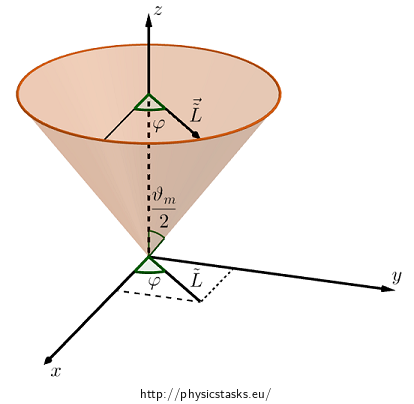
First, we verify that in this model the components \(L_x\) and \(L_y\) have zero expectation value. The projections along the \(x\)‑ and \(y\)‑axes are, according to our chosen notation,
\[ L_x = \tilde{L} \cos \varphi \, , \] \[ L_y = \tilde{L} \sin \varphi \, , \]where \(\varphi \in \langle 0, \, 2\pi \rangle\).
The expectation value for \(L_x\) is then
\[ \langle L_x\rangle = \int_0^{2\pi} \tilde{L} \cos \varphi \, \mathrm{d}\varphi \, . \]Here we integrate the cosine function over its full period. The value of the definite integral is therefore zero, i.e.,
\[ \langle L_x\rangle = 0 \, . \]Analogously, we find
\[ \langle L_y\rangle = 0 \, . \]Next, we determine the expectation values \(\left \langle L_x^2 \right \rangle\) and \(\left \langle L_y^2 \right \rangle\). We illustrate the calculation for \(\left \langle L_x^2 \right \rangle\)
\[ \left \langle L_x^2 \right \rangle = \int_0^{2\pi} \tilde{L}^2 \cos^2 \varphi \, \mathrm{d}\varphi = \tilde{L}^2 \int_0^{2\pi} \frac{1 + \cos 2\varphi}{2} \, \mathrm{d}\varphi = \tilde{L}^2 \int_0^{2\pi} \frac{1}{2} + \frac{\cos 2\varphi}{2} \, \mathrm{d}\varphi \, . \]This time we integrate the cosine function over two periods. This part of the definite integral is again zero. Overall, we then obtain
\[ \left \langle L_x^2 \right \rangle = \pi \tilde{L}^2 \, . \]Analogously, we find
\[ \left \langle L_y^2 \right \rangle = \pi \tilde{L}^2 \, . \]In this way, we have verified that the cone model satisfies \(\left \langle L_x \right \rangle = \left \langle L_y \right \rangle = 0 \,\) while the expectation values \(\left \langle L_x^2 \right \rangle = \left \langle L_y^2 \right \rangle\) are non‑zero.
To determine the apex angle of the cone, we use the results obtained in Solution b). Focusing on half of the apex angle \(\vartheta_m\), we can employ the cosine function and express this angle as
\[ \cos \frac{\vartheta_m}{2} = \frac{\langle L_z \rangle}{\sqrt{\langle L^2 \rangle}} = \frac{\langle L_z \rangle} {\sqrt{\langle L_x \rangle^2 + \langle L_y \rangle^2 + \langle L_z \rangle^2}} = \] \[ = \frac{m\hbar}{\sqrt{m^2\hbar^2 + \hbar^2 \left [ l \left (l+1 \right ) - m^2 \right ]}} = \frac{m}{\sqrt{m^2 + l \left (l+1 \right ) - m^2 }} = \frac{m}{\sqrt{l \left (l+1 \right )}} \, . \]In summary, we can state that the classical model of a quantum‑mechanical stationary state \(|lm\rangle\) is a set of angular momenta randomly distributed on the surface of a cone with apex angle \(\vartheta_m\), for which
\[ \cos \frac{\vartheta_m}{2} = \frac{m}{\sqrt{l \left (l+1 \right )}} \, . \]


